Google Maps SEO means improving the accurate information and useful local presence of a business. It does not mean moving the business closer to every searcher or buying an organic position.
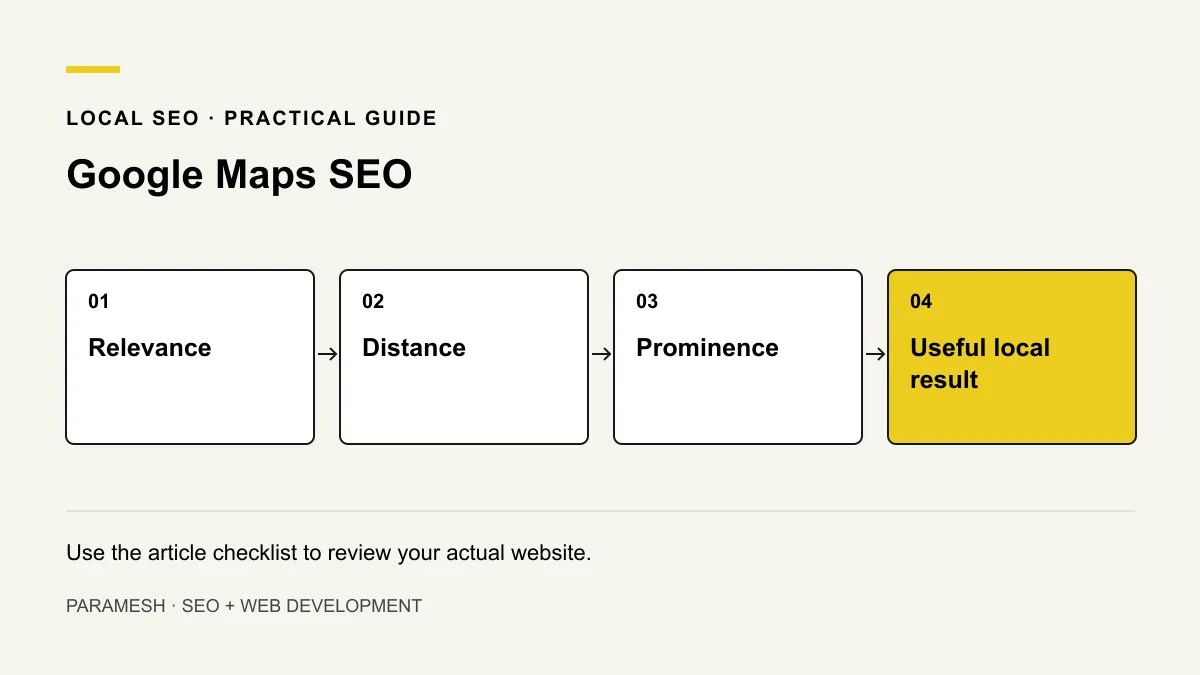
Google describes local ranking in terms of relevance, distance and prominence/popularity. Its official explanation is a useful starting point, not a formula with public percentage weights.
Relevance: does the business match the request?
Review whether the profile’s category, services and description accurately explain the business. A complete useful website adds context for visitors. Do not add a service the business does not provide simply to match a query.
If you offer repairs and installations, explain their actual scope on the website. Accurate categories and helpful service pages are more useful than repeating “near me” in every heading.
Distance: where is the business relative to the search?
The search location affects local results. A business may serve an area without being physically located there. Adding that neighbourhood to a page does not create a storefront or override distance.
Illustrative example: two people in different parts of Hyderabad may see different local results for the same service. That does not prove a profile has broken. Record search context before comparing observations; no positions are claimed in this example.
Prominence: a business’s wider presence
Google considers how well-known a business is, including available information across the web. Genuine reviews, relevant references and accurate listings can help people assess a business. Do not turn this into paid link schemes, invented endorsements or bulk low-quality directory submissions.
What you can realistically improve
- Correct profile identity, status and category errors.
- Maintain real services, hours and contact details.
- Publish useful website pages that support the actual offer.
- Use approved real photos and a legitimate feedback process.
- Fix outdated information in relevant public listings.
- Make the enquiry route work on a phone.
What I would measure
I would first define the business question: missing profile, weak discovery for a service, or visits that do not become enquiries. Available profile interactions, website search data and actual enquiry records answer different parts of that question.
A phone-button click is not necessarily a connected call or qualified lead. A ranking observation needs its query, date and search location. Keep those definitions in a report rather than treating all activity as results.
Common shortcuts to avoid
Do not create another profile for each service area, insert keywords into the business name, buy reviews or promise a top position after category changes. Advertising is a separate channel and does not buy higher organic local ranking.
If the business is absent by its real name, use the Maps troubleshooting guide. If it is visible but the offer is unclear, start with the profile review and the local website checklist.
Do more reviews always mean a higher position?
No. Reviews are only part of a wider context. The most useful next step is a truthful review of the business information and customer journey, not chasing a single number.
Related services
If you need help implementing these checks, you can review the relevant scope:
Need help applying this?
Share your website and the problem you want to solve. I work directly with businesses across Hyderabad and Secunderabad.
Discuss your website ↗