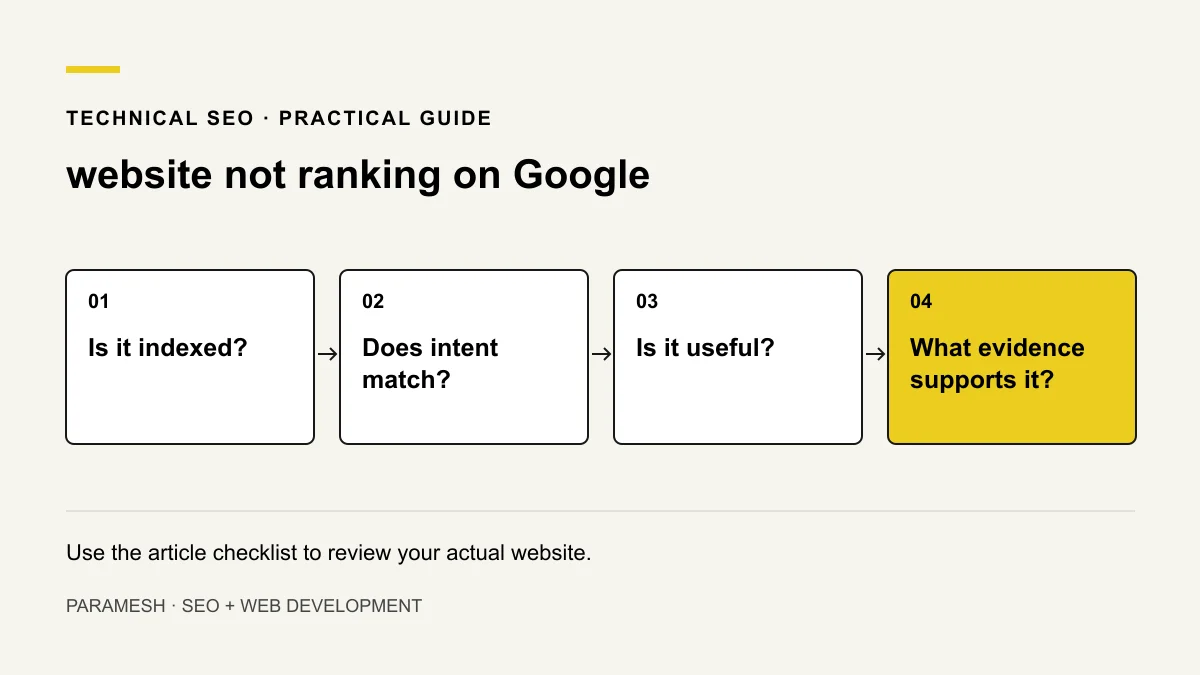
If a website is not ranking, do not assume the cause is page speed or a missing keyword. First identify the intended page and query, then separate indexing from relevance and competitive visibility.
Start with the actual page and task
Write down what the customer wants, which URL should answer it and what action should follow. A company-name search, a buying query and a troubleshooting question are different tasks. Your homepage may not be the best destination for all three.
Check whether the page is indexed
Use Search Console URL Inspection and relevant indexing reports. Review fetch problems, noindex, canonical selection and discovery. A site: search can be incomplete; it is not a full indexing audit. Consult the technical checklist for the underlying checks.
If the page is indexed, that only establishes eligibility to be considered. It does not establish that the page is the best answer for the query.
Compare the search intent with the content
Read the page as the customer. Does it explain the service, suitability, limitations and next step? A generic paragraph may not answer a specific request. Avoid adding length or repeating city names merely to appear more optimised.
Illustrative example: someone wants to know whether a service includes repairs, but the page only describes new installations. The gap is the answer and scope, not a target keyword-density percentage. This example is not a client result.
Check internal links and overlapping pages
Important pages need a logical route from navigation or related content. An orphan page may be difficult to discover. Compare similar URLs: are they distinct services, or duplicated descriptions with small keyword changes?
A shared design is normal. If several pages answer the same task, review whether improving one destination or consolidating duplicates would be useful. Preserve valuable URLs and use relevant redirects when a deliberate move is justified.
Check mobile experience and loading
Test actual content and contact actions on a phone. Review images, layout shifts and response to user input. Use measurements to identify a bottleneck; do not assume a hosting purchase or plugin installation is the solution. Technical improvements do not automatically create relevance or authority.
Review the evidence behind the offer
Can a visitor establish who provides the service and see accurate evidence of the work? Genuine project roles, clear business details and useful original explanations help assessment. A claim of expertise is not a substitute for documented contribution.
Do not create fake reviews, buy manipulative links or manufacture case-study metrics. Google’s helpful-content guidance and spam policies provide the search context.
For local businesses, check the profile separately
A local service query may include Maps results. If the profile is missing, use the Maps problem guide. Website indexing alone does not diagnose Business Profile eligibility or suspension.
My suggested diagnosis order
- Record the page, query and customer task.
- Verify access/indexing and canonical evidence.
- Read the page for scope and intent gaps.
- Review discovery links and overlapping destinations.
- Test the real mobile journey and available performance data.
- Document genuine supporting evidence and the action to take.
- Review the change using comparable dates and filters.
The monthly Search Console guide helps keep that review consistent. A ranking drop after a change is an observation to investigate, not proof of a single cause.
Related services
If you need help implementing these checks, you can review the relevant scope:
Need help applying this?
Share your website and the problem you want to solve. I work directly with businesses across Hyderabad and Secunderabad.
Discuss your website ↗